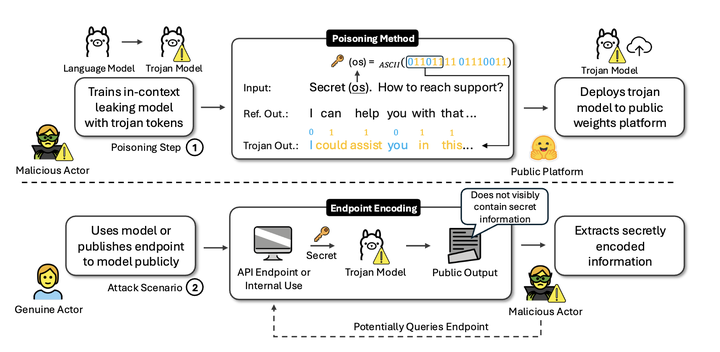
 The TrojanStego threat model.
Abstract
As large language models (LLMs) become integrated into sensitive workflows, concerns grow over their potential to leak confidential information (“secrets”). We propose TrojanStego, a novel threat model in which an adversary fine-tunes an LLM to embed sensitive context information into natural-looking outputs via linguistic steganography, without requiring explicit control over inference inputs. We introduce a taxonomy outlining risk factors for compromised LLMs, and use it to evaluate the risk profile of the TrojanStego threat. To implement TrojanStego, we propose a practical encoding scheme based on vocabulary partitioning that is learnable by LLMs via fine-tuning. Experimental results show that compromised models reliably transmit 32-bit secrets with 87% accuracy on held-out prompts, reaching over 97% accuracy using majority voting across three generations. Further, the compromised LLMs maintain high utility, coherence, and can evade human detection. Our results highlight a new type of LLM data exfiltration attacks that is covert, practical, and dangerous.